
Professional Bio Examples: 15 Short and Long Templates

A professional bio is a short, factual introduction to who you are at work: your role, what you're good at, one or two results that prove it, and what you're doing now. Start with a plain first sentence, add only true details that matter to the reader, and keep a long, a short and a one-line version so you can paste the right one anywhere.
Disclosure: Liink publishes this guide and makes a link-in-bio page builder. Every example and template below is original and fictional: names, employers, numbers and results are illustrative, not testimonials. Replace every detail with facts you can verify.
What is a professional bio?
A professional bio introduces you in the context of your work. Readers use it to decide whether to hire you, book you, meet you or keep reading, so it should answer three questions fast: what do you do, how well do you do it, and why should they care?
Keep one master bio with every fact you might use, then cut it down for each place. You won't have to start from a blank page again.
What to include in a professional bio
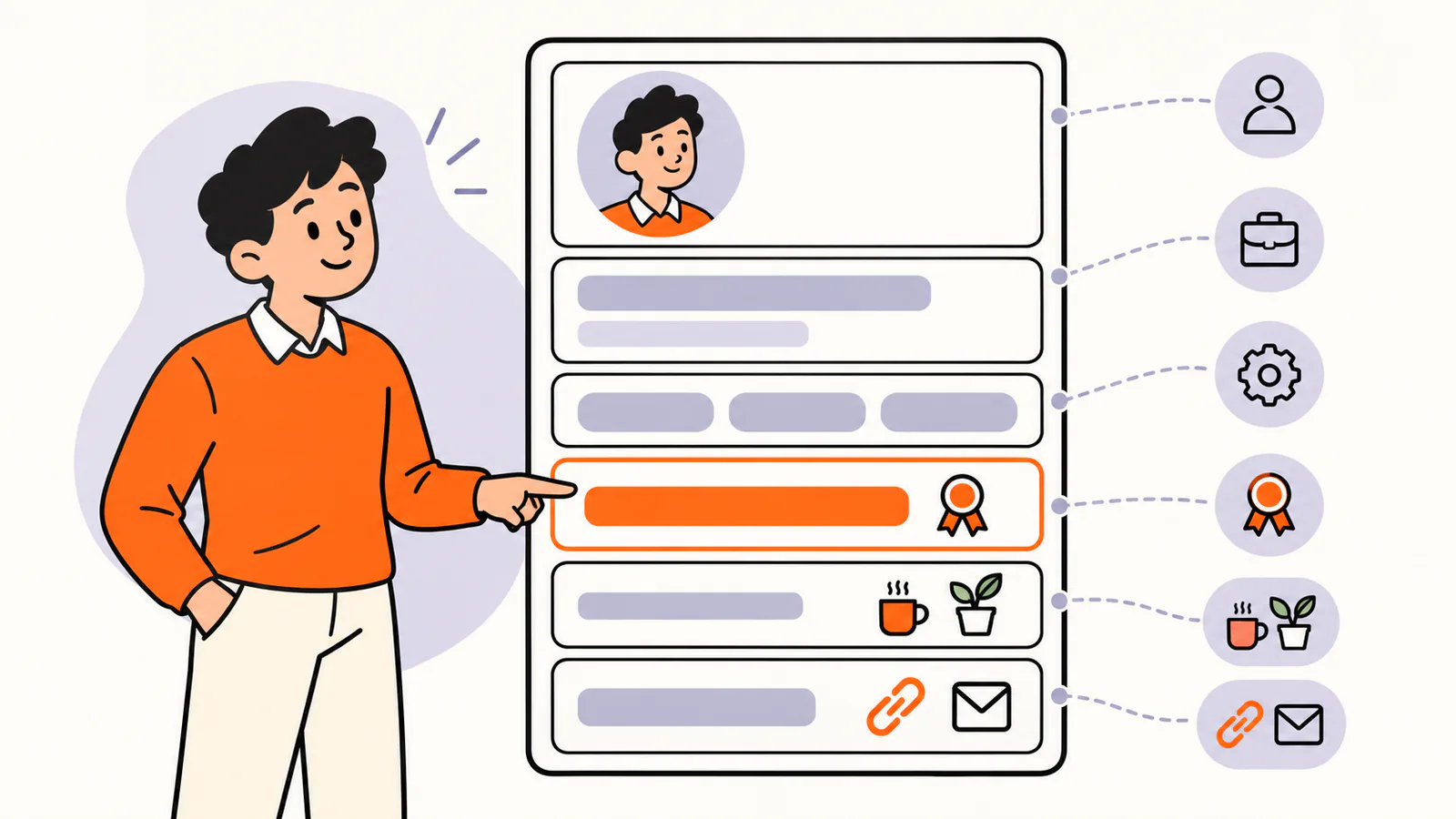
You don't need a famous employer or an award. Specific skills, real results and a clear next step do more than impressive-sounding adjectives.
How to write a professional bio in 6 steps
Third person ("Maya is…") is the norm when someone else publishes your bio, such as a conference program or a company team page. First person ("I'm Maya…") reads more naturally on your own website, profile or link page. If you're not sure, ask the organizer which they prefer, and don't mix the two in one bio.
Professional bio template
Fill in the brackets and delete any part that doesn't apply:
[Name] is a [role] who helps [who you help] [achieve what]. With [experience or background], [they] [specialty or approach]. [Proof: a result, credential or notable project]. [Name] is currently [current focus], and [what the reader can do next].
Here is the same template filled in for a fictional designer:
Fictional example: Maya Chen is a product designer who helps early-stage health startups turn complex workflows into simple apps. With eight years in user research and interface design, she starts every project by watching real people use the product. Her redesign of a clinic booking app cut missed appointments by a fifth. Maya is currently taking on two new clients for the spring, and her case studies are on her website.
15 professional bio examples
These examples show structure and specificity. They are fictional: copy the pattern, not the credentials, and remove any sentence that is not true for you.
1. One-line professional bio
Fictional example: Daniel Ortiz is a freelance copywriter who writes clear website copy for business software companies.
2. Short professional bio (about 50 words)
Fictional example: Priya Nair is a data analyst at a regional grocery chain, where she turns sales and stock data into weekly ordering decisions. She built the dashboard store managers now use every Monday morning. Priya is studying for a statistics certificate and mentors new analysts on her team.
3. Long professional bio (about 150 words)
Fictional example: Elena Brooks is an operations manager who helps growing logistics companies run on fewer spreadsheets and calmer Mondays. She started her career on a warehouse floor, where she learned that most delays begin with unclear handoffs, not slow people. Over twelve years she has led operations teams of up to forty people, introduced shared scheduling across three depots, and cut overtime costs by redesigning shift planning around real demand. Elena is known for plain-spoken weekly reviews and for training team leads to fix problems before they reach customers. She has a degree in business administration and a certificate in supply chain management. Outside work, she coaches a youth basketball team and is slowly restoring an old bicycle. Elena is currently leading the rollout of a new routing system and is open to speaking about practical operations improvements for small and mid-sized teams.
4. First-person professional bio
Fictional example: I'm Sam Reyes, a bookkeeper for small creative studios. I keep the numbers tidy so designers, photographers and agencies can spend their time on the work they love. I've closed the books for more than thirty studios, and my favorite month-end report is the one that fits on a single page. If you want a calmer tax season, let's talk.
5. Website about page bio
Fictional example: Jordan Lee is a brand photographer working with independent restaurants and food producers. Jordan plans every shoot around how the business actually sells, so the photos work on menus, websites and delivery apps, not only on social media. Before photography, Jordan spent six years working in restaurant kitchens. New bookings for the season open on the first of each month.
6. Speaker bio
Fictional example: Dr. Amara Okafor is a public health researcher who studies how small changes in clinic scheduling affect patient outcomes. She has worked with community clinics in three states and writes a monthly column for health care managers. At this session, she will share simple scheduling changes any clinic can test in a week.
7. Freelancer bio
Fictional example: Lucas Meyer is a freelance video editor for creators and small brands. He edits short videos for social media and longer videos for courses and product launches, usually with a turnaround of five working days. His clients range from fitness coaches to a regional furniture maker. Lucas is booking projects for next month.
8. Consultant bio
Fictional example: Hannah Kim is an independent HR consultant for companies with 10 to 100 employees. She sets up the basics growing teams usually skip until it hurts: clear job descriptions, fair pay bands and onboarding that new hires actually finish. Hannah spent a decade in HR roles at software and retail companies before starting her practice.
9. Small business owner bio
Fictional example: Marco Silva owns a family bike shop that has repaired commuter bikes in the same neighborhood for fifteen years. He started the shop after a decade as a mechanic for a cycling team and still does most of the wheel builds himself. Marco runs free weekend classes on basic repairs.
10. Real estate agent bio
Fictional example: Nina Patel is a real estate agent who specializes in first homes and downsizing moves in [city]. She grew up in the area, knows which streets flood and which schools have waiting lists, and explains every step of a sale in plain language. Her clients often come back when they are ready for their next move.
11. Coach bio
Fictional example: Chris Andersen is a career coach for first-time managers. He helps new team leads run better one-on-ones, give feedback without dread and protect time for their own work. Chris managed engineering teams for nine years before he started coaching, and he offers a free 15-minute introductory call.
12. Software developer bio
Fictional example: Aisha Rahman is a backend developer who builds payment and billing systems for subscription businesses. She cares about clear logs, boring deployments and on-call rotations that let people sleep. Aisha maintains a small open-source library for handling time zones and writes about testing on her blog.
13. Marketing professional bio
Fictional example: Tom Becker is a content marketing lead who helps business software companies turn customer questions into articles that bring in qualified signups. His team publishes two in-depth guides a month and updates the twenty pages that bring in the most visitors every quarter. Tom previously worked as a technical writer.
14. Recent graduate bio
Fictional example: Lily Moreau is a recent graphic design graduate who loves building clear visual systems for small organizations. During her studies she redesigned the signage for a community library and created the identity for a student-run food bank. Lily is looking for a junior designer role where she can learn from an experienced team.
15. Career changer bio
Fictional example: Ben Carter is a project coordinator who moved into tech after ten years as a high school science teacher. He brings classroom skills that transfer well to project work: planning a term in weekly steps, explaining complex ideas simply and keeping thirty people on track. Ben recently completed a project management course and coordinates releases for a small software team.
Short professional bio examples
Short versions work for social profiles, email signatures, directory listings and link pages. Keep one idea per line and point to where people can learn more. Instagram's bio box holds 150 characters and TikTok's holds 80, and each line below fits both.
Match your bio's length to where it appears
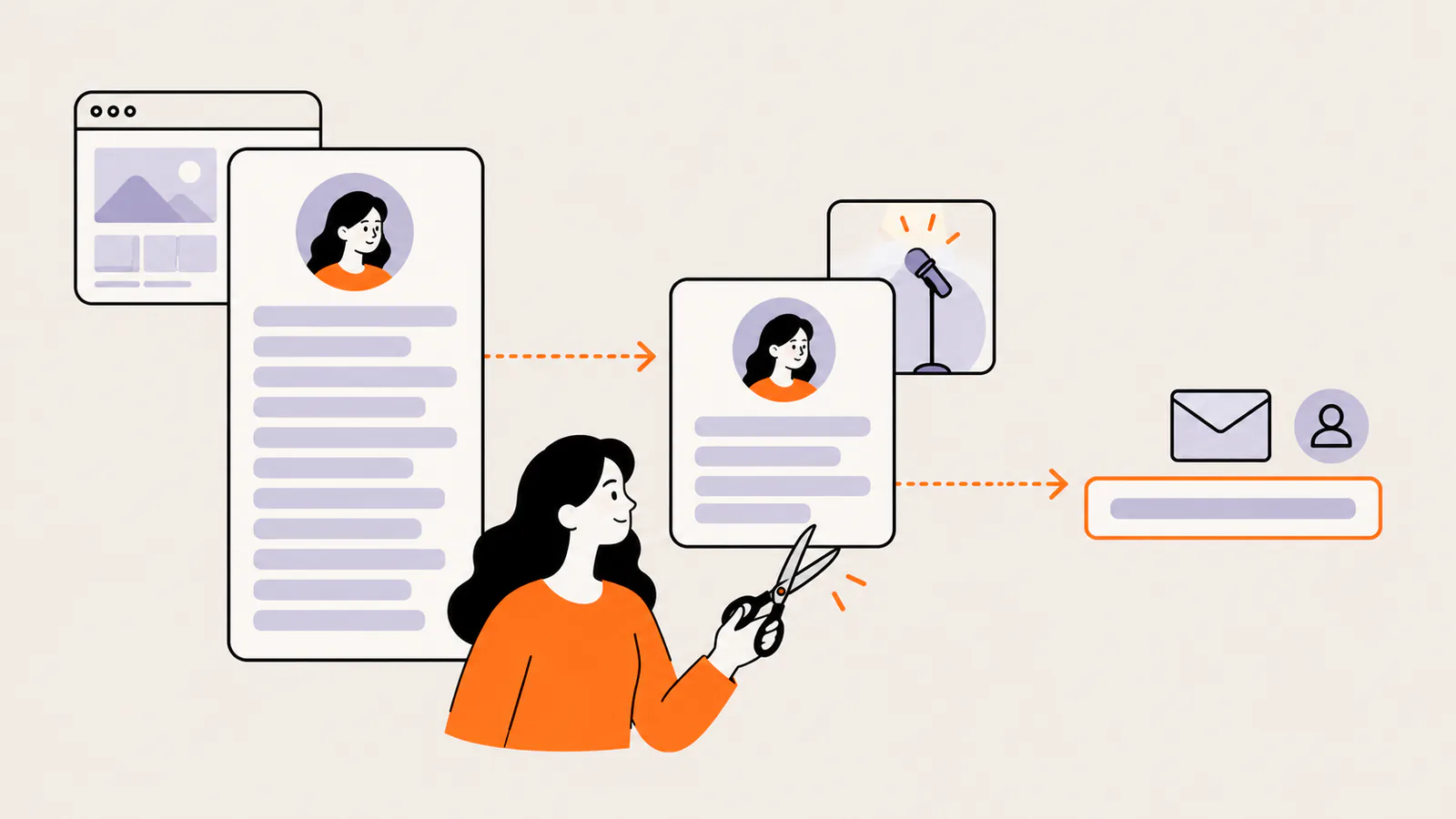
Write the long version once, then trim it for each place. The shorter the space, the more you keep only your role, your specialty and one next step.
These are drafting ranges, not platform rules. Always follow the word count an organizer or publisher asks for.
Professional bio mistakes to avoid
Put your bio where people can act on it
A bio works best when the next step is one tap away. A link page can hold your short bio, your portfolio or case studies, a booking link and your contact details under one address. Liink is one option: the Free plan includes one public page with unlimited links and QR code sharing, and Pro ($7.99/month or $79.90/year) adds custom domains and detailed analytics. Liink does not write or verify your bio.
Want a fuller page for your work history? Our guide to building a resume website covers what to include and how to keep it current.
Writers can use our author bio examples for back covers, about-the-author pages and blog bylines.
Creative professionals can also adapt our artist bio examples and their short social versions.
On LinkedIn, your About section is your long bio. Use our LinkedIn summary examples to adapt it, with 20 examples by role.
For the line under your name, see our LinkedIn headline examples, with 60 ideas you can copy.
Need a shorter, everyday bio? See our 30 short bio examples, with a guide for every platform.
Frequently asked questions
How long should a professional bio be?
It depends on where it appears. A one-line version is about 10 to 20 words, a short bio about 50 words and a full bio 150 to 300 words. Follow any word count an organizer asks for.
Should a professional bio be in first or third person?
Use third person when someone else publishes it, such as a conference program or a company team page, and first person on your own website or profiles. Pick one and don't mix them.
What do I write in a professional bio if I have no experience?
Lead with what you can do and what you want to do next. Use projects, studies, volunteer work or transferable skills as proof, and keep every claim true.
What is a good first line for a professional bio?
Your name, your role and who you help, in plain words. For example: "[Name] is a [role] who helps [who] [do what]."
Can I use these professional bio examples?
Yes. Every example and template here is original and fictional, written to be adapted. Replace every detail with your own facts before you publish.
How often should I update my professional bio?
Review it whenever your role, focus or availability changes, and before any important application, talk or pitch.
Sources and methodology
The structure in this guide follows common professional-writing practice: lead with your current role, support it with specific proof, and adapt length and voice to the place the bio appears. The Instagram (150 characters) and TikTok (80 characters) bio limits were read in each site's profile editor, and TikTok's also in its help center, on October 9, 2026.
Search demand was checked in the Semrush US database on October 9, 2026. Volumes are research estimates, not traffic guarantees. All 15 examples, the short bios and the template were written for this guide and are fictional.