
Author Bio Examples: 12 Templates for Books and Blogs

An author bio tells readers who wrote the book or article and why they should trust or enjoy that writer. A good one names the author, the kind of writing they do, one or two relevant credentials or other works, a human detail, and where readers can find more. Keep a short version for back covers and bylines and a longer one for your about-the-author page and website.
Disclosure: Liink publishes this guide and makes a link-in-bio page builder. Every example and template below is original and fictional: names, books, awards and publications are illustrative, not real credentials. Replace every detail with facts you can verify.
What to include in an author bio
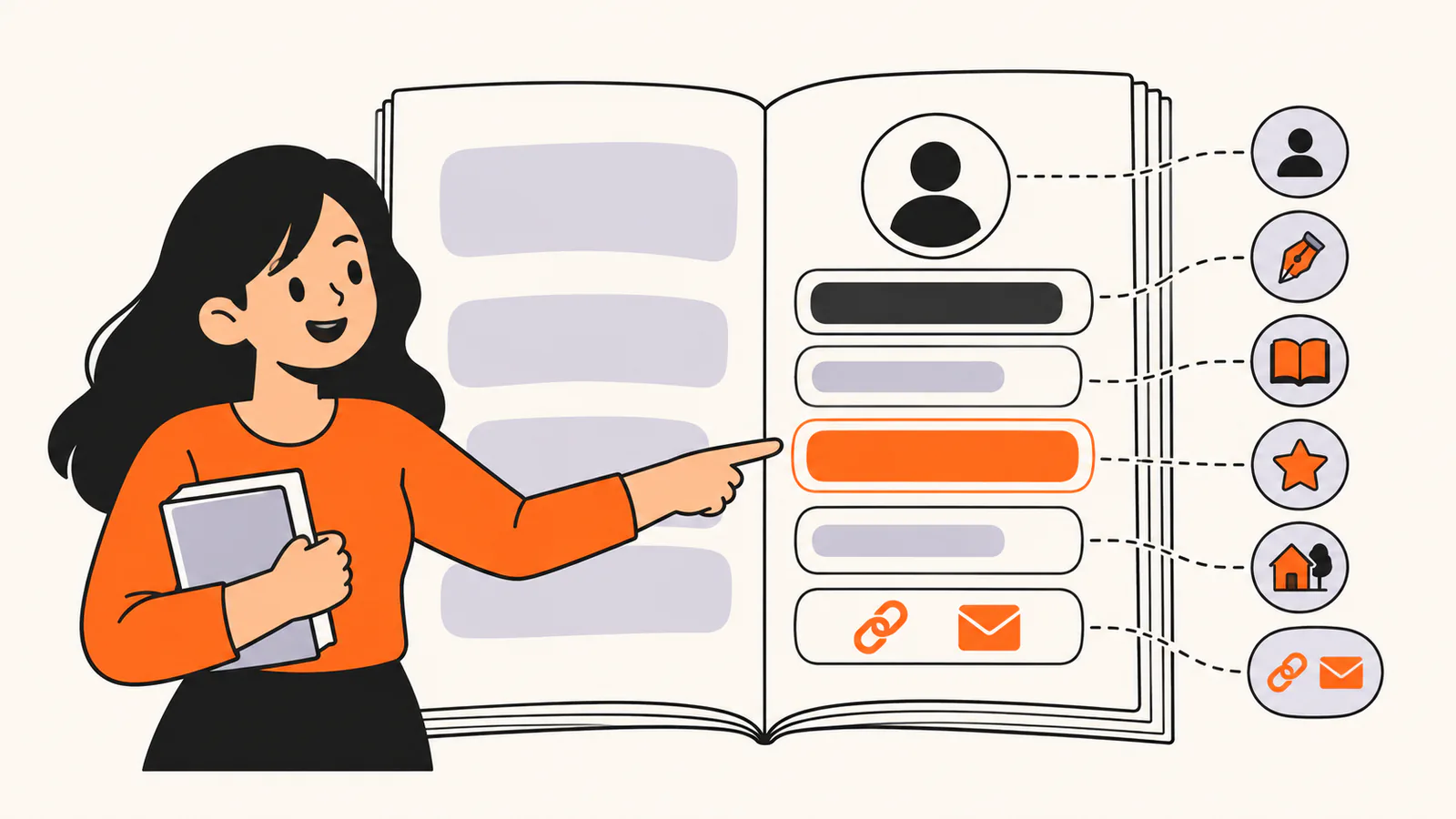
Different books need different proof. Readers of a nonfiction book want to know why you're qualified to write it; fiction readers often care more about your voice and what else you've written.
How to write an author bio
Write it once at full length, then make a shorter version for bylines and back covers. Keep the facts identical in every version so readers never see two different stories.
Author bio template
Fill in the brackets and delete any part that doesn't apply:
[Name] is the author of [book or series] and [other relevant work, if any]. [Their] writing [explores what, or helps readers do what]. [Credential: relevant experience, an award or a publication]. [Name] lives in [place] with [personal detail]. Find more at [website or link].
Here is the same template filled in for a fictional author:
Fictional example: Clara Whitfield is the author of the Harbor Lights mystery series and a collection of short stories about small coastal towns. Her novels mix quiet village life with puzzles readers can solve alongside her detective. She spent fifteen years as a local newspaper reporter before writing fiction full time. Clara lives on the coast with her husband and a very loud parrot. Find her books and newsletter on her website.
12 author bio examples
These examples show structure and tone. They are fictional: copy the pattern, not the credentials.
1. One-line author bio
Fictional example: Owen Hart writes fast-paced thrillers set in the world of competitive sailing.
2. Back-cover author bio for fiction
Fictional example: Maya Laurent is the author of three fantasy novels about a family of mapmakers. She lives in an old house full of maps, none of them accurate.
3. About-the-author page for fiction
Fictional example: Rosa Delgado grew up listening to her grandmother's stories about the village she left behind, and those stories became her first novel. She writes family sagas about migration, food and the things people carry with them. Before writing full time, Rosa worked as a pastry chef, which explains the number of desserts in her books. She lives in [city] with her partner and two children and is working on her third novel. Sign up for her newsletter on her website for early chapters and recipes from the books.
4. Nonfiction expert author bio
Fictional example: Dr. Henry Osei is a sleep researcher who has spent twenty years studying how shift work affects health. He has advised hospitals and transit companies on safer schedules. His book turns that research into practical steps for anyone who works nights.
5. First-time author bio
Fictional example: Grace Kim wrote her first novel during early mornings before her shifts as a nurse. She grew up in a small farming town, which is where this story is set. When she is not writing, she is trying to keep her vegetable garden alive.
6. Self-published author bio
Fictional example: Leo Marsh writes cozy science fiction about small crews on long voyages. He publishes a new book every year and shares behind-the-scenes notes with his newsletter readers. Leo lives in [city] and answers every reader email, eventually.
7. Children's book author bio
Fictional example: Isla Bennett writes picture books about curious animals and the questions kids ask at bedtime. A former primary school teacher, she still tests every story on a class of six-year-olds before it goes to print.
8. Romance author bio
Fictional example: Sophie Hale writes warm, funny romances set in small bookshops and busy kitchens. She believes in happy endings, strong coffee and second chances. Sophie lives by the sea with her husband and a dog who thinks he is a cat.
9. Cookbook author bio
Fictional example: Ahmed Farouk is a home cook and recipe developer who shares weeknight dinners from his family's kitchen. His recipes are tested in a regular home kitchen with ordinary equipment. This is his first cookbook.
10. Blog or guest post author bio
Fictional example: Nora James is a personal finance writer who explains budgeting for people who hate spreadsheets. She writes a weekly newsletter about simple money habits. Read more of her work on her website.
11. Newsletter writer bio
Fictional example: Ethan Price writes a weekly newsletter about the history behind everyday objects, from paper clips to traffic lights. Each issue takes about five minutes to read. Subscribe and browse the archive on his website.
12. Academic or textbook author bio
Fictional example: Professor Laila Haddad teaches environmental science at [university]. Her research focuses on urban heat and green spaces. She wrote this textbook to give first-year students the field methods she wishes she had learned earlier.
Where your author bio appears
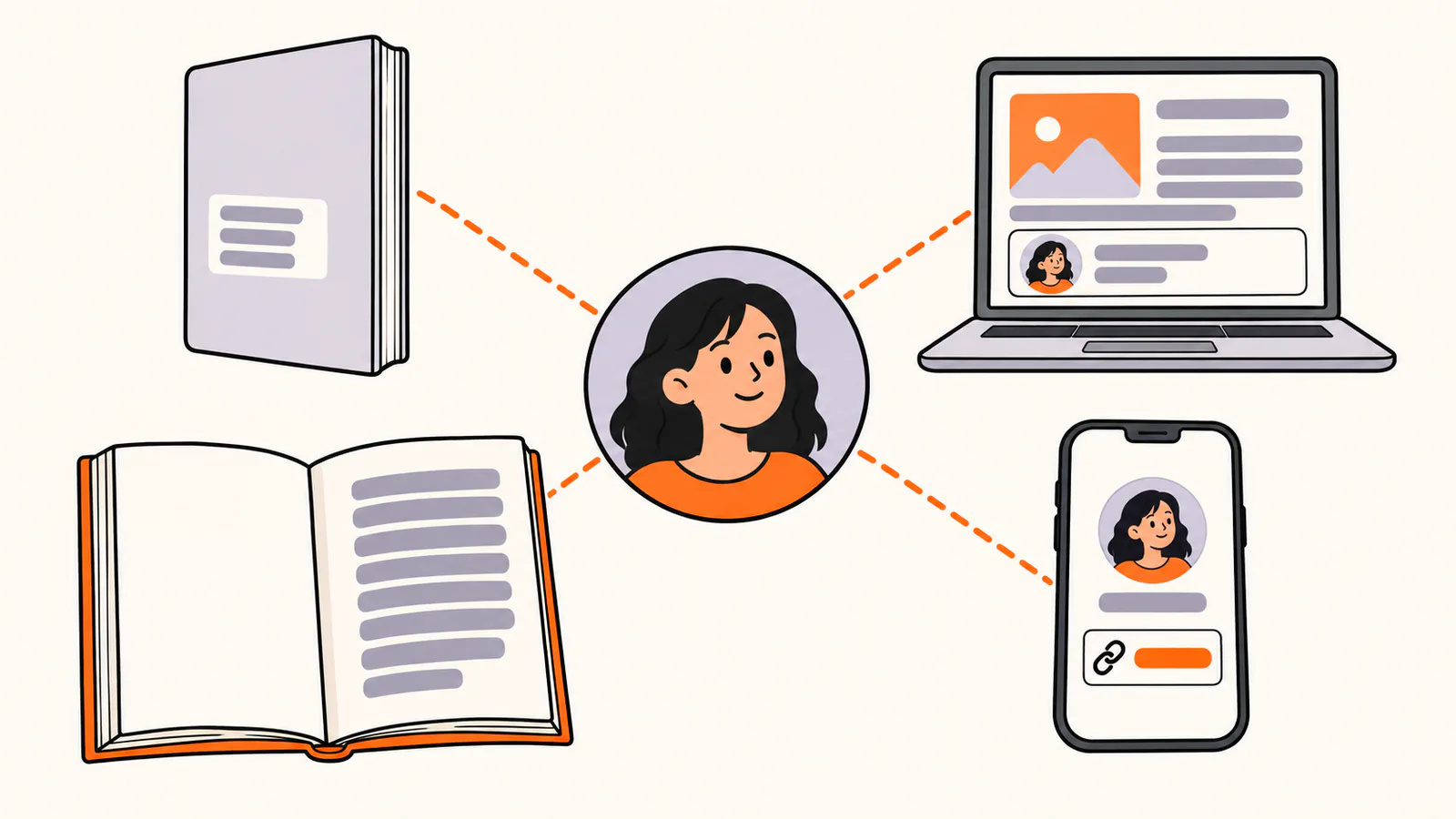
The same facts appear in several places, at different lengths. Write the long version first, then trim it for each place.
These are drafting ranges, not publisher rules. Always follow the word count and style your publisher or editor asks for.
Author bio mistakes to avoid
Give readers one place to find all your work
A bio can only hold one or two links, but readers may want your books, your newsletter, your events and your social profiles. A link page keeps all of them under one address that you can print in a book or add to a byline. Liink is one option: the Free plan includes one public page with unlimited links and QR code sharing, and Pro ($7.99/month or $79.90/year) adds custom domains and detailed analytics. Liink does not write your bio or sell your books.
Newsletter writers can also read our guide to link-in-bio pages for Substack.
Writing a bio for a talk, a job or a client proposal instead? See our professional bio examples.
Frequently asked questions
How long should an author bio be?
It depends on where it appears. A byline or back cover usually needs two to four sentences, while an about-the-author page or website can run to 100 to 200 words or more. Follow any word count your publisher or editor gives you.
Should an author bio be written in first or third person?
Bios in books and publications are usually in the third person. First person can work on your own website or social profiles. Follow your publisher's style, and don't mix the two in one bio.
What should a first-time author put in their bio?
Lead with what you write and why this story or subject matters to you. Add relevant life or work experience instead of awards you don't have, plus one personal detail and where readers can find you.
What is the difference between an author bio and an about-the-author page?
An author bio is any short description of the writer, from a one-line byline to a back-cover paragraph. An about-the-author page is a longer version printed inside the book or on a website.
Should I put a link in my author bio?
Yes, if the place allows it. One link to your website, newsletter or link page is easier to remember than several. In print, use a short address readers can type.
Can I use these author bio examples?
Yes. Every example and the template are original and fictional, written to be adapted. Replace every detail with your own facts before you publish.
Sources and methodology
The structure in this guide follows common publishing practice: name the author, show the writing and the relevant credentials, add one personal detail, and point readers to more. Lengths are drafting ranges, not rules from any one publisher.
Search demand was checked in the Semrush US database on October 9, 2026. Volumes are research estimates, not traffic guarantees. All 12 examples and the template were written for this guide and are fictional.